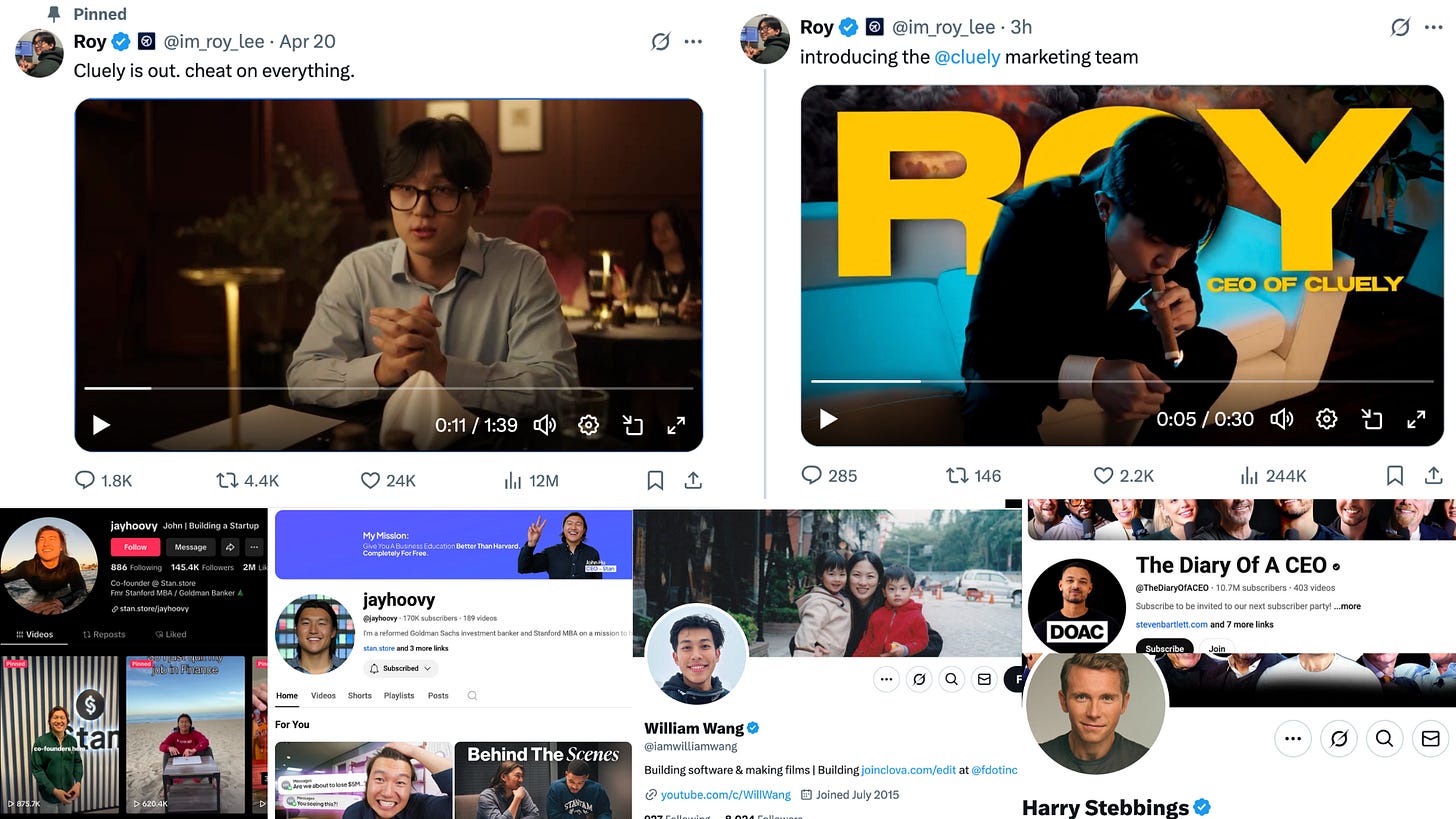
*cut off in the image, harry stebbings 20VC youtube channel
Millennials and digital-native Gen-Z have blurred the lines between being an influencer and owning their product. Some don’t just represent distribution. They are distribution.
Roy Lee doesn’t write tweets. He throws grenades.
Cluely doesn’t chase likes. It builds gravity.
You don’t scroll past them. You get pulled in.
And Roy is not alone. Jay Hoovy is rewriting YouTube/TikTok shorts with tempo and tension. William Wang has turned design-driven storytelling into a brand that clips itself. Harry Stebbings turned a newsletter and a mic into a machine. Diary of a CEO turned overexposure into aesthetic religion.
These people aren’t content creators. They’re distribution technicians. They don’t just post. They multiply.
Roy Lee and Cluely: Native to the Feed
Roy Lee is what happens when you mix contrarian instinct with perfect timing. He doesn’t need threads. He drops single-line punches that move through the timeline like scripture. Every post is a line of code for how X thinks.
Cluely’s weapon is rhythm. He understands silence. White space. Tension. His posts feel like watching someone reload a thought in real time. And when the visual hits, it’s clean enough to brand a movement.
Behind the scenes, Roy’s team plays a real part in how well Cluely’s content lands. Instead of throttling Roy’s marketing ability, they are active participants, like characters in a Star Wars cantina, or a Friends like sitcom. By allowing Daniel Min to run YouTube, their growth will just skyrocket from here. If they are able to get an intern to go viral successfully, you’ll have a hype house for founders in no time. And for their intended target market, that's exactly what they need.
I truly believe that Lucy Guo should buy Keith Rabois’ Miami home and turn it into a startup content creator compound. It markets Passes. Keith becomes Miami’s nuclear Mr. Beast. Everyone wins.
The cofounder duo of Roy and Neel Shanmugam perfectly blends the artistic discipline of Brian Chesky-level design with Tiktok-native reach.
Cluely creates meta.
And the kicker? You never had to follow them. They found you anyway.
Jay Hoovy and William Wang: YouTube’s Native Species
John Hu, who goes by the name Jay Hoovy, doesn’t make videos. He makes dopamine loops. Each short is a smile filled cold open, a punchline, and a setup for the next.
He blends Gen Z energy with media savvy. Humor with motion. Commentary with charisma. He’s not “just posting” - he’s controlling pacing like a director. This absolutely works for Stan’s brand, as it’s targeted towards all creators, especially ones on TikTok trying to monetize their brand in an all-in-one platform.
William Wang, on the other hand, is minimalism meets sharpness. His storytelling is clean, tight, idea-first. He doesn’t need spectacle - the frame is the brand. He blends his background in video into his content, where his startup Clova allows you to edit videos with simple prompts, his video’s are minimalist while also conveying a meditative clarity. Each video is low-key, but high signal.
Harry Stebbings and DOACEO: The Podcast Industrialists
Harry Stebbings plays long games fast. He went from cold-start kid to venture insider because he treated podcasting like a launchpad. Every guest is leverage. Every question is networking. Every post builds equity. And it worked. Harry raised one of Europe’s largest venture funds through hard work and a creative medium.
And Diary of a CEO? It’s not just a podcast anymore. It’s a media shrine.
Stephen Bartlett intrigues the viewer with interesting guests, slow zooms and emotional hooks. You don’t even have to agree with the show to be hooked by the aesthetic. Every frame screams intentionality. Every clip has a face, a feeling, a sentence designed to interrupt your feed.
Both Harry and Stephen have the ability to further their venture firm and presence through a creative medium, and its worked.
In earlier waves, Jason Calacanis stood almost alone with the insersection of media and startups with “This Week in Startups”, and later the All In podcast with Chamath Palahapitiya, David Sacks and David Friedberg. Jason proved that owning the conversation meant owning the pipeline.
Today, that playbook’s evolved - not replaced, but multiplied. Harry and Stephen are building firms where the microphone isn’t a side project. It’s the front door.
They Don’t Just Post. They Build Loops.
All these creators understand the platforms they’re on better than the platforms understand themselves.
-
They write for the feed, not just from the mind.
-
They post like founders, not freelancers.
-
They turn style into substance.
-
They design feedback loops, not just algorithms.
This is the new distribution class. They aren’t waiting to be discovered. They’re showing up in your feed until you have no choice but to pay attention.
We’re not in the era of “content” anymore.
We’re in the era of behavioral gravity.
And the people who know how to pull you in? They’re going to own the next wave.
Where does that leave you and me?
For me, anything I do under Hardspace (even on hard_space YouTube) — will never become a source of income, and it’s definitely not a newsletter. It’s a broadcast tower. A signal. An artistic escape to write the future in real time, before it happens.
Because while I’m building cryptographic rails for the physical world — trust, movement, identity, — this is where the story gets told first.
I’m not here to monetize your clicks. I’m here to build alignment.
With founders. With misfits. With people who can feel the ground shifting beneath them and want to help lay the new foundation.
You don’t have to agree with everything I say. You just have to recognize that something is changing - and it’s worth paying attention to.
For you?
Create. Film. Distribute. That’s the new playbook — and the future’s already running it.