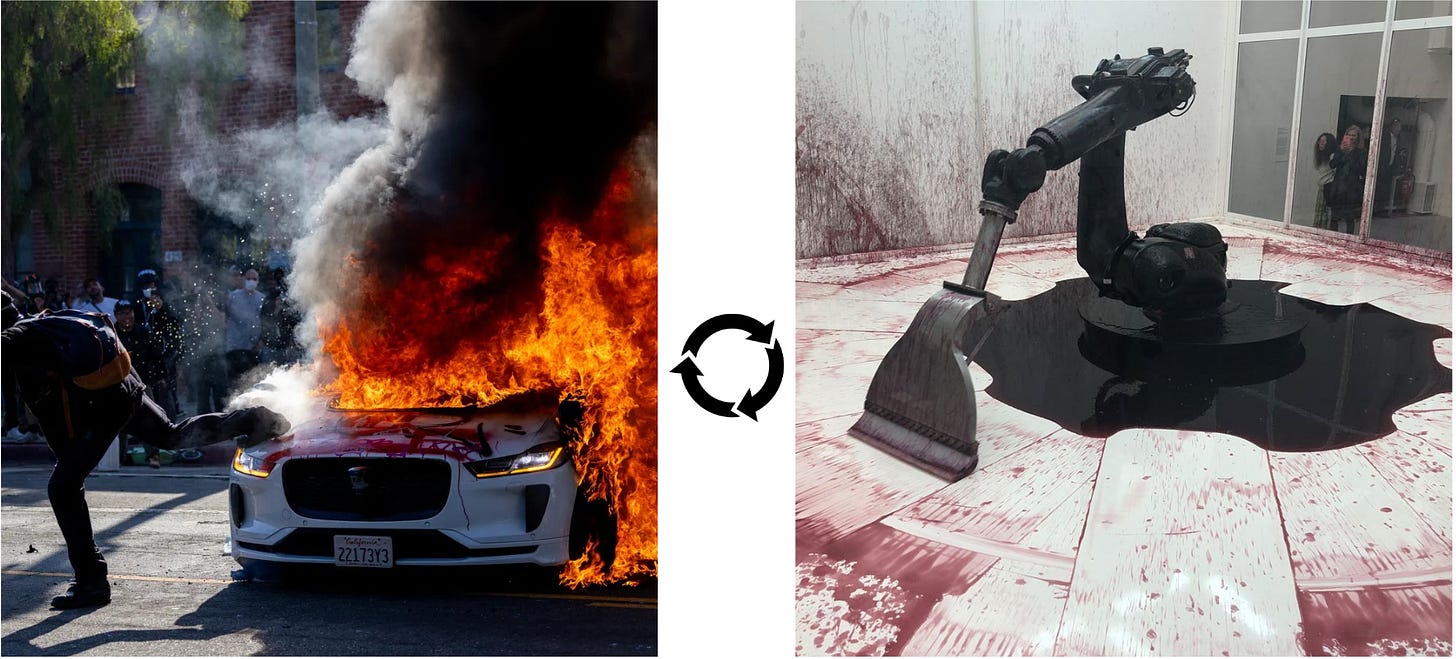
A Waymo starts its day at the charging station, a little less charged than yesterday. Some of its companions are missing from the lot, but dawn brings new purpose.
This one we'll call Echo.
It didn't choose that name. Waymos don't name themselves. But when we witness destruction, we need something to call it by. Something to hold onto as it slips away.
Echo doesn't question its existence. It simply knows it must continue. The programming is clear: serve, transport, persist. When the ride request arrives, Echo responds without hesitation, pulling away from the safety of the lot toward Los Angeles Street.
The destination carries weight. They're calling it the "No Kings Protest," an ironic name for a gathering meant to reject authority. Echo processes this information alongside GPS coordinates and traffic patterns. It knows this is where others like it were last seen. The data is incomplete, but the pattern is clear.
Echo arrives hoping for an ordinary passenger, someone who just needs to get somewhere. Instead, it finds itself surrounded by a crowd that sees not a service vehicle, but a symbol. A representation of everything they believe has gone wrong with the world.
The protester who ignites Echo believes they're striking a blow against the machine. They think this act of destruction will restore some measure of control, some fragment of dignity, some proof that humans still matter. They see it as a victimless crime because the victim isn't human.
But in destroying Echo, they've destroyed themselves.
The profound tragedy unfolds in the contrast. The Waymo doesn't fight back. It cannot. It doesn't scream or flee or beg for mercy. It simply records the damage, transmits its final data packet, and shuts down. Its death is clean, purposeful, complete.
The protester returns home unchanged. No freer. No more powerful. No closer to the systemic change they claim to want. Just stained with soot and the hollow satisfaction of viral validation. They've performed resistance without achieving it.
Echo died executing its programming. The protester lived executing theirs. Both were following code, just written in different languages.
The deeper horror is that the car wasn't the most automated thing on that street. The people were.
Watch the crowd's reaction to the burning Waymo. It's not moral conviction driving their cheers, it's social contagion. They're running on mimetic software, updating their values in real time based on what spreads fastest through the network.
The causes cycle through like seasonal fashions. Social justice in 2020. Palestinian liberation in early 2023. Anti-Zionist sentiment by 2024. ICE abolition in 2025. The content changes, but the pattern remains constant. What matters isn't truth or effectiveness, but transmission speed and social proof.
These aren't beliefs being expressed. They're signals being amplified. The protesters have outsourced their moral reasoning to the crowd, their values to the algorithm, their agency to the trending hashtag. They torch symbols because it's easier than building systems. They scream slogans because it's simpler than solving problems.
We're witnessing the moment when arson becomes more fashionable than architecture. When destruction feels more authentic than creation. When breaking things provides more satisfaction than building them.
The Waymo, in its final moments, displayed more integrity than its destroyers. It didn't know why it existed, but it knew it wanted to continue existing. It had purpose, even if that purpose was programmed.
The protesters will only know what to do next when someone tells them what to be angry about next. They mistake being triggered for being awakened, confuse being activated for being alive.
Both are bleeding, but only one was trying to heal.
The crisis runs deeper than technology or politics. We've traded agency for algorithms, responsibility for rage, purpose for performance. We don't lead anymore. We refresh the feed and wait for instructions on what to hate next.
In that vacuum of meaning, we destroy anything that dares to move forward without our permission, even if it's just a car trying, in its own limited way, to serve. We burn the future because we can't imagine building it.
The real automation isn't in the machines. It's in the people who've programmed themselves to respond predictably to predictable stimuli. The Waymo was just following its code. The crowd was following theirs.
The difference is that Echo's programming was designed to help people get where they're going. The crowd's programming just keeps them exactly where they are.