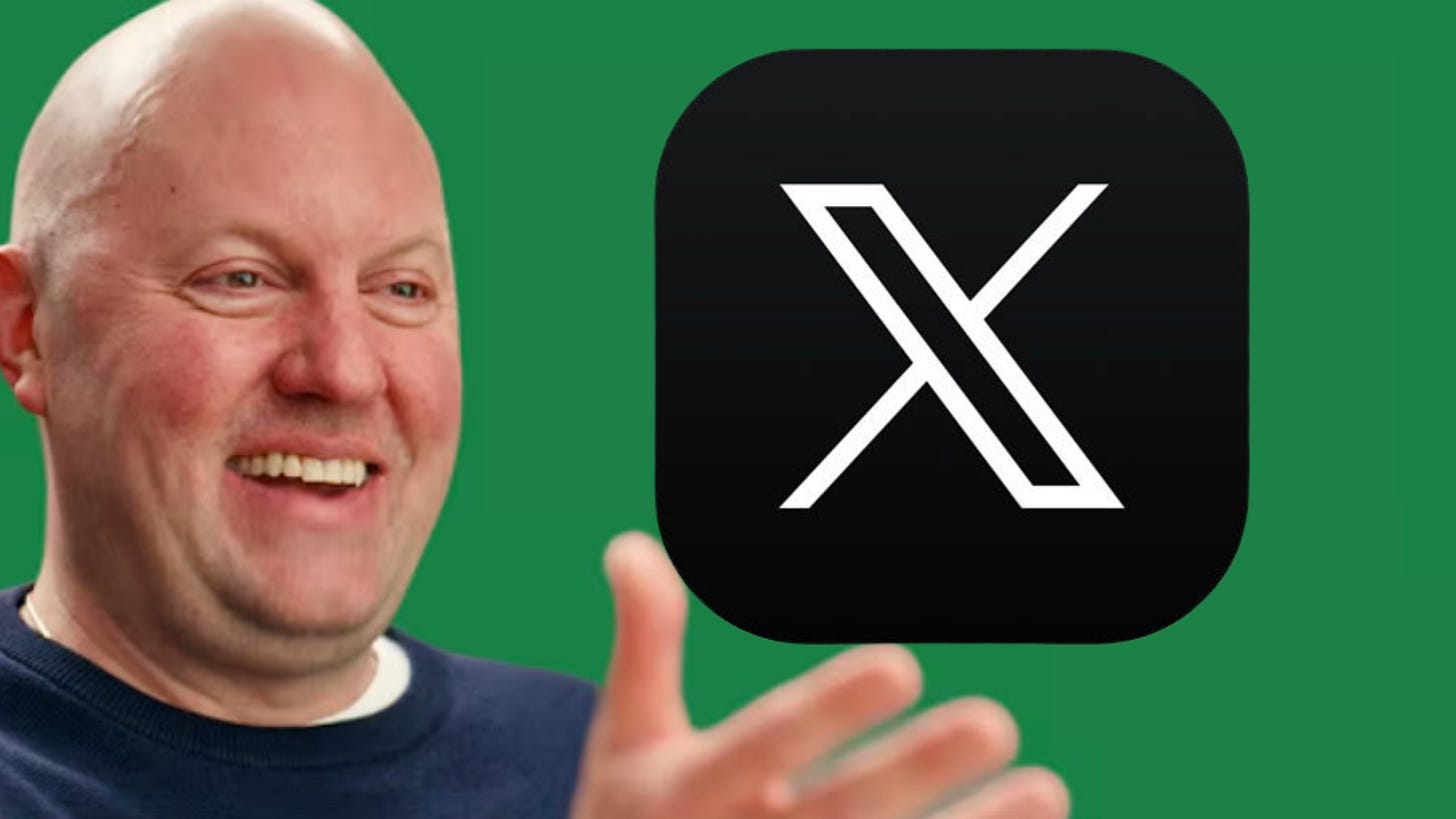
this guy is glowing. have VC’s discovered skincare? joy? snail mucin? snail mucin is the new SaaS.
I recently stumbled upon the “Uncapped” podcast hosted by Jack Altman, and listened to Marc Andreessen talk about how X has become the “X” ray of truth, and having redownloaded the app, I would say that’s absolutely true.
I made a Twitter account when I was 11, back in 2014, because it was kind of the cool place to find memes. I used it for about 30 minutes, and got bored perusing. I ended up mothballing the platform for years, as there was no one actually talking about relevant information, or at least information that I cared about. When X was acquired by Elon in 2022, I thought, “that’s cool, I guess”. I supported Elon Musk’s idea of the “everything app”, but I was still under the belief that X was going to continue being the same intellectually removed environment that it was in 2014, therefore building anything off of it was pointless, but if there was anyone to make it work, it would be Elon.
Having redownloaded the app 8 days ago, I’m now addicted.
In comparison to TikTok, Instagram, Threads, or the failed hellhole Bluesky, X represents a source of raw truth, for anyone, liberal or conservative. Its a true “town square” of opinions, letting the loudest voices speak, but allowing the counter voices speak too via a simple “quote” or reply.
Through a simple post, anyone can challenge the narrative in real time — and sometimes win.
X collapses the monologue
Traditional media sources still clings onto the belief that a newsroom, a credential, a byline give you authority. But the reality is that people don’t trust monologues anymore.
On X, a story gets posted — and within 30 seconds:
-
An expert in the field is dissecting the technical errors
-
A person on the ground is posting firsthand video
-
A nobody with a sharp eye is pointing out the contradiction
And suddenly, what felt like “truth” is being revised in real time. Truth isn’t centralized anymore, it’s co surfaced. What makes X powerful isn’t just that people can post — it’s that everyone can post next to eachother.
-
A world leader posts propoganda. A 19-year-old quote tweets it with satellite photos.
-
A breaking news outlet posts a sanitized version of an event. A witness uploads the raw video.
-
A viral chart goes unchalllenged — until a pseudonyms account runs the numbers and calls bullshit.
This isn’t chaos. It’s truth triangulation. It’s messy, but it’s closer to reality than anything polished on TV and legacy media.
The future of media is adversarial by default
Old media assumes the reporter is the voice of reason, whereas X assumes the crowd will correct you if you’re wrong, and that assumption reshapes everything.
It creates a media layer that’s:
-
More holistic (you see every side, not just one)
-
More interactive (you engage, not just consume)
-
More accountable (bullshit gets called out fast)
X didn’t invent free speech, as a New Englander, I know well that people up here were screaming to the wind many years ago.
For years, though, the ability to spread one’s word was throttled, and X commoditized free speech. There is a great account on both YouTube and X, TBPN hosted by well known YouTuber John Coogan and Jordi Hays, (they’re both more than just YouTuber personalities), where they follow John’s thesis on successful differentiation: showcasing the individual.
I wholeheartedly believe that the media landscape is going to go in TBPN’s direction, in comparison to stiff, Jim Cramer or nightly news like content, but that’s not a fully formed thought at this time. In the meantime, I’ll be skimming through their content as I’m unfortunately too over-employed to view two to three hours of amazing video, while simultaneously having enough free time to tactically shit-reply (borderline harass) venture capitalists on X while my two EA’s do the real work.
What traditional media can’t compete with
They can’t out-speed X.
They can’t out-source X.
They can’t out-reply X.
Legacy media’s model is: observe → interpret → deliver.
X’s model is: observe → distribute → debate → revise → meme.
Guess which one wins?
So yeah — X is the X-ray.
It reveals the fractures in narratives. It shows what’s under the surface of official language. It lets truth compete in the open.
Not everyone likes what it reveals, but pretending it’s not happening is like ignoring an X-ray because you don’t like what it shows you.
And for once, the people closest to the story don’t just get quoted. They get to speak.
The cracks in Web2 are showing
What X is surfacing isn’t just fractures in news coverage - it’s fractures in the entire architecture of centralized information.
We’re watching, in real time, what happens when the crowd is smarter than the institution. When the best source of information isn’t the verified checkmark - it’s the pseudonyms account with context and conviction.
The platform isn’t perfect. But it’s doing something old media and Web2 never could.
It’s letting truth compete on open rails.
And that’s where all this points - to a future where the infrastructure of media isn’t owned by companies.
It’s owned by the people who contribute to it.
This change isn’t entirely about money, it’s about ownership. Taylor Swift’s recent buyback shows that Web3 needs to happen, but alas, that’s another not fully formed thought that’ll possibly come later. Zeno of Citium and Marcus Aurelius probably wrote in spits and starts, guys. Daily Stoic just sees the result. I can probably talk about how a content creator 2,000 years from now is going to find a Substack or X post and treat it like its the ten commandments for our life, and then make a career off of convincing others to follow them.
Remember kid-dults, the grift is in the text.
Web3 doesn’t just make X better - it makes it inevitable.
X today is accidentally behaving like a proto-Web3 platform.
-
Permissionless publishing
-
Real-time, adversarial fact-checking.
-
Pseudonyms identity with reputation
The next step?
-
On-chain context
-
Portable reputation
-
User-owned networks
If X doesn’t evolve toward a Web3 future, something else will - and fast.
Because people don’t just want to speak; they want to own a piece of the system they’re powering.
So yes - X is the X-ray.
But maybe it’s also the CT scan of what the internet is becoming.
And it’s only going to get clearer from here.